
Feeding the Follicles You Still Have
Your own concentrated platelets, placed into the scalp to support follicles that are thinning but not yet gone.
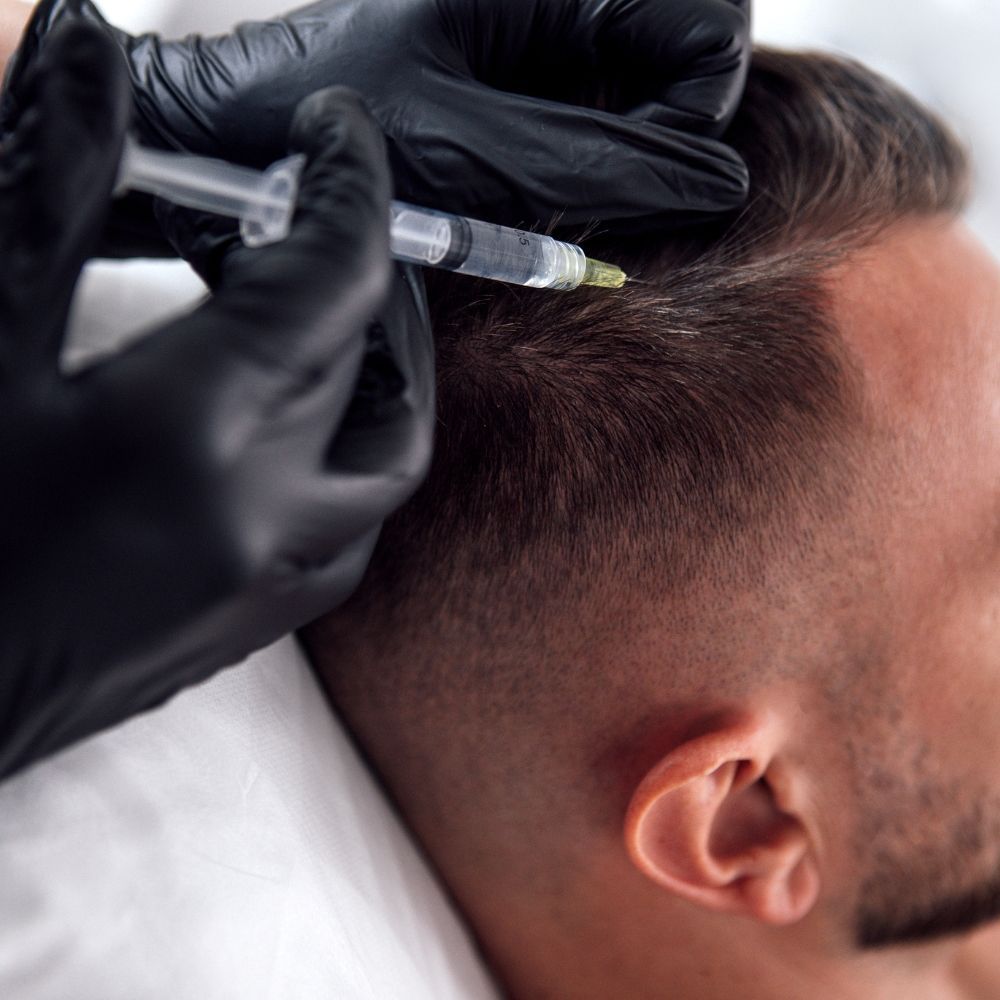
Growth Factors, Placed at the Root
A small sample of your blood is drawn and spun in a centrifuge to concentrate the platelet rich fraction. That concentrate is then injected across the thinning areas of the scalp, delivering growth factors directly to the follicles.
The distinction that matters is this. PRP supports follicles that are still alive and struggling. It does not resurrect follicles that have already died and been replaced by scar tissue, and no injection can. That is why timing decides how much you get out of it, and why we would rather see you early than late.
For the right person it slows shedding, thickens the hair shaft and improves density. For someone who has waited too long it does very little, and we will tell you which category you are in rather than sell you a series either way.
A Good Fit If Any of This Sounds Familiar
Certain blood conditions and medications rule this out. We go through your history first.
Three Steps, Start to Finish
We Look at the Scalp Properly
Pattern, density and whether the follicles in the thinning area are still viable. That decides whether PRP is worth your money.
Drawn, Spun and Injected
The blood draw and preparation take most of the appointment. The injections themselves are quick.
We Space the Series
An initial series spaced across several months, then maintenance. We will tell you what that schedule realistically looks like.
Earlier Is Worth Far More Than Later
Platelets support follicles that are still alive. Once a follicle is gone, nothing in a syringe brings it back.
Shedding Slows Before Density Returns
What Growth Factors Do at the Follicle
Platelets carry growth factors including PDGF, VEGF and IGF-1. Delivered into the tissue around a follicle, they stimulate the dermal papilla, improve local blood supply and appear to extend the active growth phase of the hair cycle.
A hair follicle cycles between growth, transition and rest. In androgenetic loss the growth phase shortens with each cycle and the shaft produced gets finer, until the follicle produces almost nothing. Lengthening that growth phase is the mechanism PRP is aiming at.
The evidence is reasonable for early to moderate thinning and weak for advanced loss, and preparation technique varies enough between clinics that results do too. Because the material is autologous, there is no risk of reaction to the preparation itself.

What People Ask Us First
There is some discomfort during the scalp injections. We use techniques to reduce it and most people find it very manageable.
An initial series over several months, then maintenance. We will give you a specific expectation after assessing your scalp rather than before.
Not where the follicle is gone. It supports follicles that are still there and struggling, which is why coming in early matters so much.
Yes, and it is a sensible pairing. Surgery relocates hair, PRP supports what surrounds it. Neither one does the other's job.
Yes. Female pattern thinning often responds well, particularly when it is caught early. The assessment is the same.
Often Considered Alongside This
The Best Time to Treat Thinning Is Now.
Come in and we will tell you honestly whether the follicles in the thinning area are still worth supporting.
4211 N. Buffalo Road, Suite 15, Orchard Park, NY 14127
